02 / Multiplayer strategy game
Santorini.
A Java board game brought to the browser, with a shared rules engine, online rooms and a React interface. Play with friends or practise against the computer.
- Java
- Spring Boot
- React
- TypeScript
- WebSockets

Overview
Santorini is a strategy game in which players move workers, construct towers and compete to reach the winning height. The application began as a university Java desktop project and was later extended with a multiplayer service and a browser interface.
The original desktop application was developed by Team024, including me. My subsequent work adds the Spring Boot game service, React and TypeScript browser client, online rooms, accounts, computer practice and deployment architecture.
Reusing the game core
The rules live in a headless Java core that can be used by the server and desktop application. Keeping game logic separate from presentation allows the existing desktop project to support a different client without duplicating the rules in JavaScript.
The browser and desktop clients can join the same online rooms. The browser focuses on rendering, input and feedback, while the service coordinates the authoritative game state.
Multiplayer state and consistency
Clients submit actions rather than replacing the board state. The server checks the player’s seat, turn and legal moves before broadcasting an updated snapshot. Snapshot versions help reject actions based on an outdated view of the room.
The project also includes ranked results and account preferences. Completed results persist, while active rooms and chat are held in memory. This is an explicit limit of the current single-server deployment: restarting the service ends active rooms.
Interface and accessibility
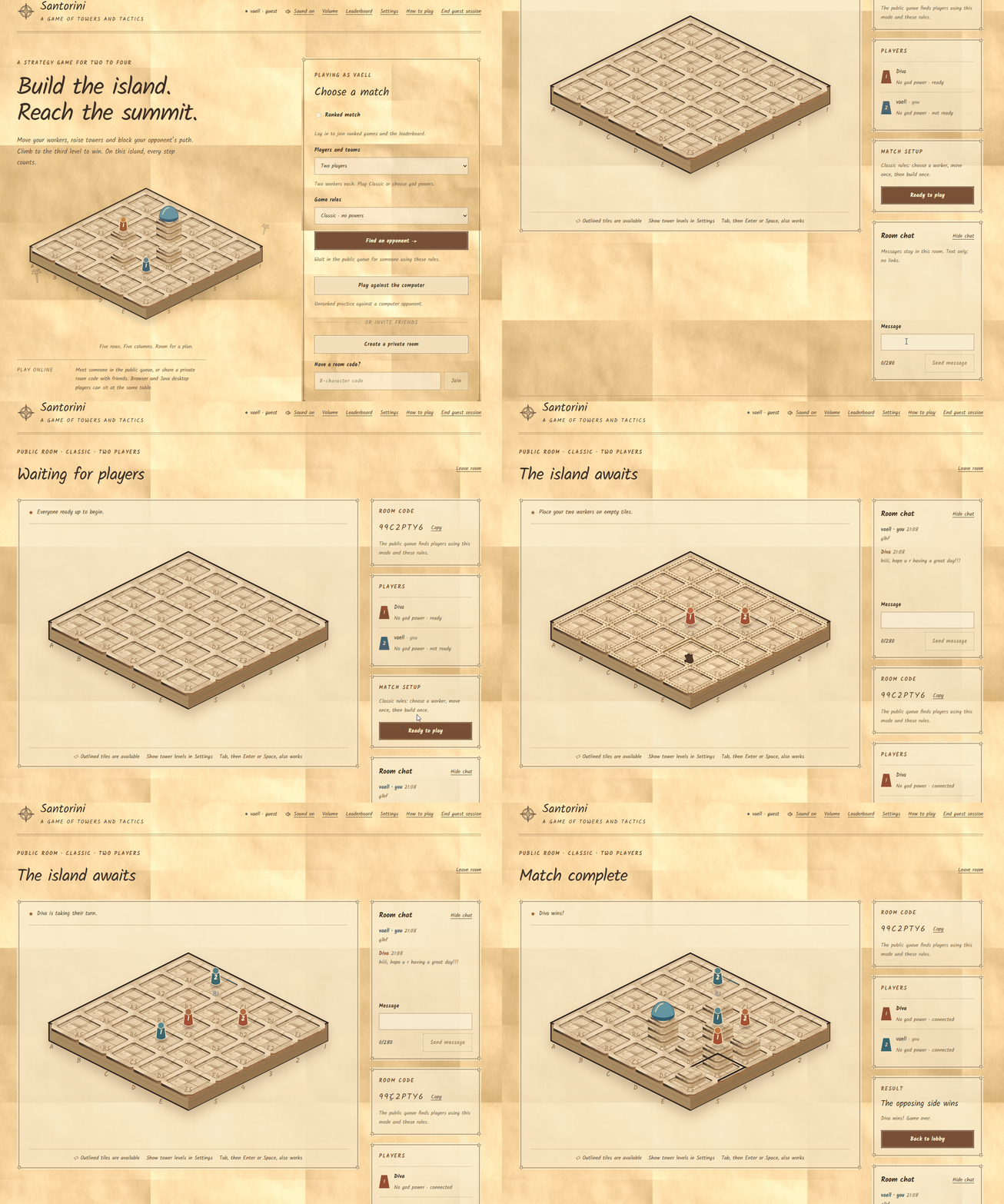
The browser interface uses a parchment palette, an isometric board, tool cursors and sound controls to reflect the tabletop game. Optional tower-level labels and keyboard controls provide additional ways to read and interact with the board.
Testing and deployment
Java tests exercise the rules and service behaviour, while frontend and browser checks cover room flows and interface interactions. Docker Compose and Nginx support the deployment on AWS Lightsail.
The repository documents the room protocol, architecture and current scope. The live game provides a way to explore how those decisions appear in the interface.