03 / Creative developer tool
CRT Visual Downscaler.
Turn images, GIFs and short videos into limited-palette artwork. A reusable C++ engine, compiled to WebAssembly, does the processing on your device.
- C++
- WebAssembly
- TypeScript
- React
- Web Workers
Overview
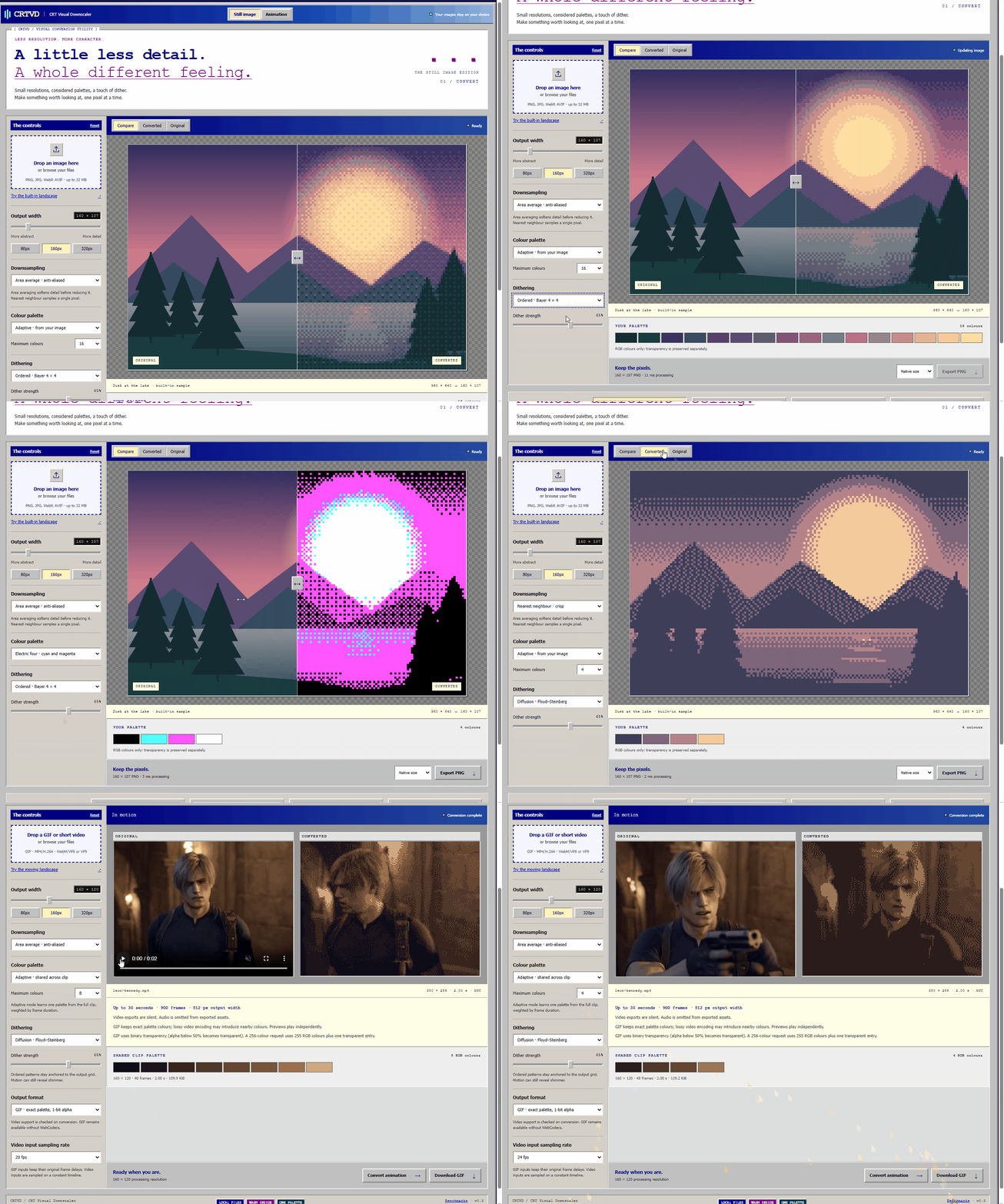
CRT Visual Downscaler transforms photographs, GIFs and short videos into downscaled, palette-limited and dithered artwork. It is designed for experimenting with constrained resolution and colour, with a browser editor for interactive use and reusable tooling for other projects.
The processing takes place on the visitor’s device. Media does not need to be uploaded to an application server, and the interface can show local previews while the user adjusts the output.
One processing core
The C++ engine works with RGBA pixel buffers independently of the interface, file paths and image codecs. Emscripten compiles it to WebAssembly for browser use, while a native build supports a command-line tool.
A TypeScript package exposes the engine to the web editor and other applications. This gives the processing logic a defined interface and keeps its memory ownership and disposal requirements visible to callers.
Colour and animation
The engine supports resolution reduction, palette quantisation and dithering. Area resampling treats light and transparency explicitly, while palette matching uses Oklab colour space.
For animation, analysis first builds a shared palette for the clip. Frames can then be processed using the same set of colours, reducing the inconsistency that can arise when each frame is analysed independently.
Keeping the interface responsive
Web Workers host the processing work away from the main interface thread. The editor provides progress feedback and cancellation for animation jobs, and discards obsolete still-image results when settings change.
Testing and current scope
Native and Wasm tests, reviewed reference images, package checks and browser tests cover the engine and its entry points. The repository also includes benchmark conditions and reproducible measurement commands.
The current effects prepare retro-inspired assets. They do not simulate CRT hardware, phosphor masks or screen curvature. Browser codec support determines which animation formats are available; supported profiles and processing limits are documented in the repository.